The package is attractive. Can you produce it?
A beautiful pouch cannot answer a shelf-life question. Neither can an attractive product photograph establish line compatibility, print tolerances, minimum order quantities, or whether the supplier can support an approval process. Those details are where many packaging decisions actually happen.
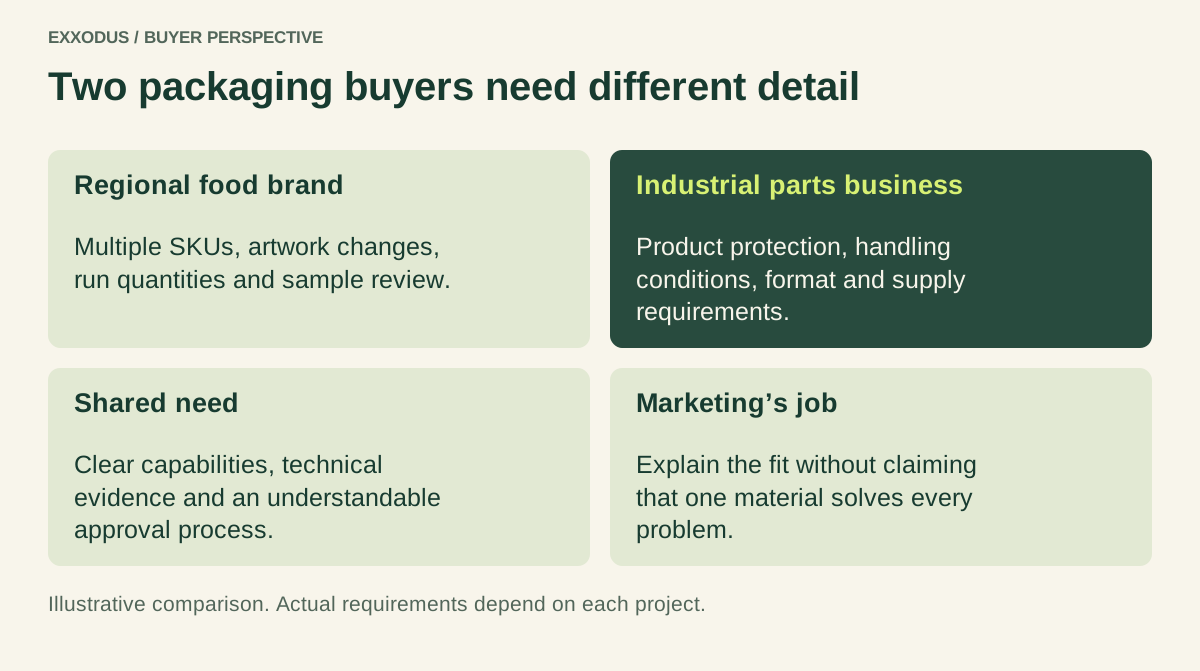
Marketing for packaging manufacturers needs to connect visual appeal with the technical and commercial evidence buyers use to assess fit. It also needs to distinguish very different audiences: a regional food brand launching multiple SKUs is not evaluating a supplier in the same way as a pharmaceutical converter or an industrial parts manufacturer. The following framework turns those differences into clearer positioning, more useful content, and stronger sales conversations.
Marketing for packaging manufacturers should make technical fit, commercial requirements, and evidence easier to evaluate. This is business-to-business communication about manufacturing capability, not consumer packaging design advice. The audience is choosing a supplier that must deliver reliably under specific product, equipment, quality, and purchasing conditions.
Segment by application, not by everyone who needs a bag
A regional snack producer, a pharmaceutical contract packer, and an industrial parts supplier may all purchase packaging, but their constraints differ. Define the applications you can serve profitably and the requirements you can support. Consider formats, substrates, print processes, order volumes, geography, service capabilities, and qualification expectations.
A useful customer profile describes the trigger: launching a new SKU, replacing a material, addressing transit damage, reducing changeover complexity, or seeking a second qualified source. It also identifies who approves the change. Marketing becomes more specific when it knows what makes a packaging project feasible and what makes it unsuitable.
Explain materials without promising magic
Buyers may need to compare structures, barrier properties, seal performance, printability, durability, and end-of-life considerations. Explain which properties matter for the application and what must be tested. A claim such as 'better barrier' is incomplete without naming the relevant property, conditions, and comparison.
Do not imply that a material is recyclable everywhere or suitable for food contact merely because a supplier description sounds reassuring. Claims about compliance and environmental performance require jurisdiction-specific, application-specific verification. Your marketing can describe the documentation and testing process without making claims the technical team has not approved.

Make format and production requirements visible
A buyer should be able to identify the formats you manufacture, relevant dimensional ranges where appropriate, print options, finishing capabilities, and factors affecting minimum orders. You do not need to publish every proprietary detail. You do need to prevent obviously unsuitable inquiries and reduce repetitive clarification.
Explain that quoted quantities and lead times may depend on material availability, artwork approval, tooling, production schedules, and project requirements. If you cannot offer a universal minimum, say how the minimum is determined. A precise explanation of uncertainty is more helpful than a confidently misleading number.
Turn the sample process into a confidence builder
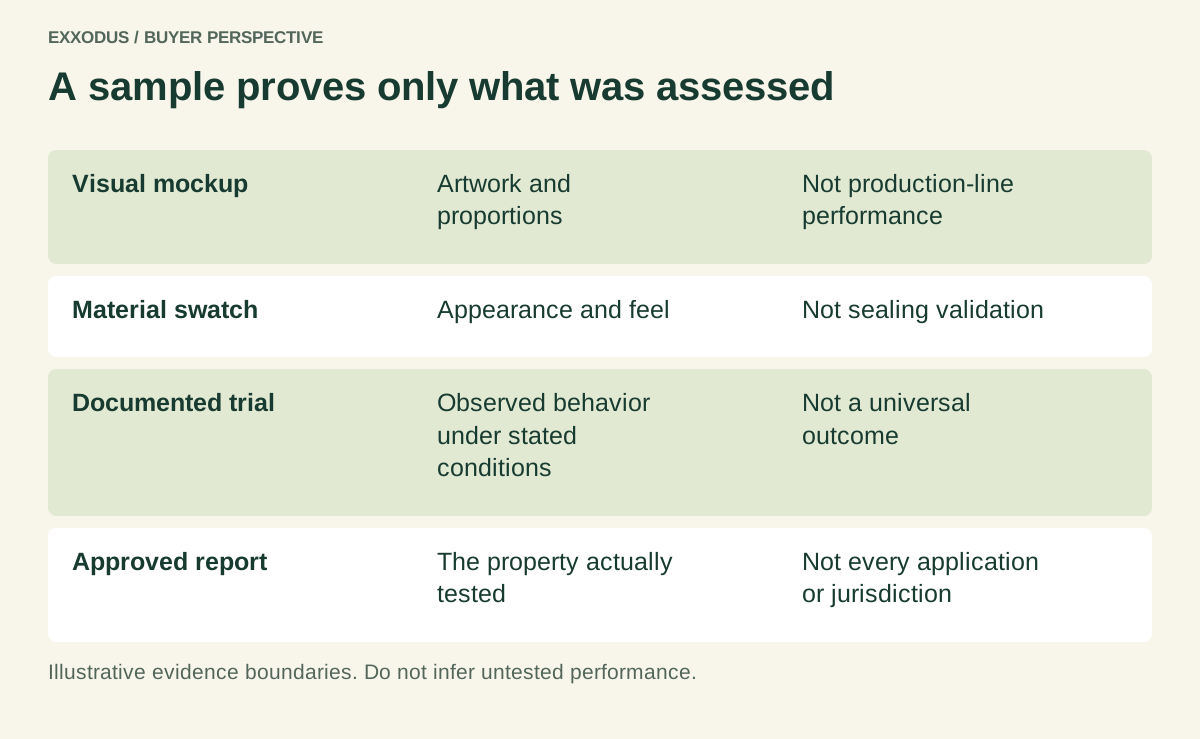
Packaging buyers need to understand what a sample proves. A visual mockup may help assess artwork and dimensions but not establish performance on a production line.
A material swatch may show appearance and feel but not validate sealing behavior. A trial run can generate useful evidence under stated conditions, with limitations that should be documented.
Outline the steps: gather application requirements, review available structures, agree on what the sample is intended to test, document evaluation criteria, assign approvals, and confirm next steps. Explain what information the buyer must supply and what your team will return. Clear expectations reduce the chance that two departments use the word 'approved' to mean entirely different things.
Use comparisons that help procurement and engineering
A balanced comparison might examine digital and flexographic printing for a specific project, noting that suitability depends on run length, artwork variability, substrates, finishing, quality requirements, and supplier capabilities. Avoid universal winners. Show which variables influence the decision and which claims need validation.
For another application, compare stock packaging with custom production. A stock format may support a faster initial need, while custom work may offer application-specific options subject to tooling, volumes, and approval. The marketing value lies in clarifying trade-offs, not announcing that the option you sell is automatically superior.
Build proof around the actual packaging job
A useful case study describes the product, packaging problem, constraints, selected approach, validation process, and measured result when permission and evidence are available. If the customer cannot be named, obtain approval for an anonymized account. Never imply that an unverified hypothetical improvement came from a real client.
A photograph of a finished pouch is not proof of barrier performance, line compatibility, or shelf-life extension. Match each claim with appropriate evidence.
If a test was performed under particular conditions, say so. This protects buyers from overgeneralizing and protects the supplier from promising what the project never established.
Give sales the right technical materials
A packaging sales toolkit might include an application intake form, capabilities overview, material comparison guide, artwork preparation checklist, sample-process explanation, and approved case studies. Give each asset a clear use. A prospect exploring options needs different information from a buyer who has a finished specification and requests a quote.
Coordinate messaging across direct sales, distributors, and customer service. If one channel promises any quantity and another explains a minimum production run, trust erodes quickly. Align the website, sales materials, and proposal language around what the factory can actually deliver.
Choose channels around commercial intent
Search content can answer application questions, comparisons, and supplier evaluations. LinkedIn can make technical expertise visible to purchasing, product development, and operations professionals.
Trade shows and distributor relationships can support direct evaluation. Choose channels based on the customers and applications you want, not on a generic manufacturing marketing checklist.
NIST's Manufacturing Extension Partnership supports small and medium-sized U.S. manufacturers through its national network. Its resources are useful broader manufacturing context, not evidence that any particular packaging tactic guarantees sales. Ground your channel decisions in qualified inquiries, commercial fit, and what your team can support.
A 60-day packaging communication plan
Days one through fifteen: choose a target application and review recent RFQs, lost projects, and common technical questions. Days sixteen through thirty: clarify capabilities, limits, and the sample process.
Days thirty-one through forty-five: create one comparison guide and one approved demonstration or case example. Days forty-six through sixty: distribute through sales and relevant channels, then review inquiry quality.
Measure how often buyers provide the information needed for a useful first assessment, how frequently sales repeats basic explanations, and which inquiries fit your production capabilities. A rise in unsuitable quote requests is not automatically progress. The objective is better matching between real customer needs and actual manufacturing strengths.
What to ask before commissioning packaging content
Before writing a packaging article, ask the technical team what formats and materials it actually supplies, which applications are common, which claims are validated, what trial procedures exist, and which constraints are commercially important. Ask sales what buyers misunderstand and which inquiries waste time because a fundamental requirement was unclear. Ask customer service what becomes confusing after an order is placed.
These answers should shape the article outline and its practical examples. They also reveal where the company needs better internal documentation rather than better marketing language. An elegant explanation cannot compensate for a sample process nobody has agreed on or a product specification that has not been approved.
Before publication, have a knowledgeable reviewer examine every application claim, minimum-order explanation, testing reference, and material comparison. The aim is to give buyers a useful starting point while keeping technical feasibility decisions with the people qualified to make them.
A practical quote-readiness checklist
Before a buyer requests a packaging quote, it helps to assemble the intended application, approximate annual and initial volumes, dimensions or format requirements, available artwork, preferred material properties, and target schedule. Some buyers will not know every answer, and that is fine. The supplier should explain which unknowns require a technical conversation and which can be estimated provisionally.
Make clear that a preliminary budget discussion is not the same as a validated production quotation. The purpose of the checklist is to reduce unnecessary back-and-forth and identify feasibility questions early, not to transfer all the engineering work to the customer.
Keep promises operational
A packaging claim is useful only when the manufacturing, quality, and customer-service teams can support it. Before promising fast approvals, flexible minimums, or unusual material options, confirm the actual process and its limits. Good marketing does not invent capability; it makes the capability that exists easier to evaluate.
A packaging inquiry that qualifies itself
A good initial inquiry process helps a buyer describe the product category, intended packaging format, approximate dimensions, expected volumes, material or barrier requirements if known, printing needs, timing, and available artwork. It should not demand details the buyer cannot reasonably know before speaking with an expert. Distinguish an exploratory feasibility question from a fully specified RFQ.
Give both a route forward. The first needs guidance; the second needs a reliable evaluation and response. A long mandatory form can discourage the very projects your technical team is well placed to develop.
Artwork is part of the buying experience
Packaging projects often involve several approval participants: brand, regulatory or quality, procurement, and production. Explain what files and specifications are needed, how proofs are reviewed, who signs off, and what changes after approval may affect the schedule. Keep the explanation aligned with your actual process.
A buyer should know whether a visual proof confirms appearance only or also represents production-ready specifications. Clear documentation reduces late surprises and gives your commercial team a consistent way to explain responsibilities.
Avoid the sustainability adjective trap
Words such as 'green,' 'eco-friendly,' and 'sustainable' are too broad to explain a material's actual attributes. Describe the specific property you can substantiate, the conditions under which it applies, and the relevant collection or processing limitations. Do not imply universal recyclability, compostability, or environmental superiority without evidence.
Ask technical and legal reviewers to check the claim against the applicable market. Good communication may sound less exciting than a giant green badge, but it is more useful to buyers who must defend procurement decisions.
What a capabilities page should make clear
Organize capabilities around applications and practical requirements. State the formats and processes offered, relevant material options, finishing or printing capabilities, and the steps for technical assessment. Show approved examples and explain what they demonstrate.
Distinguish standard offerings from custom development. If particular materials or order ranges are outside your scope, be candid. The page should help buyers recognize a possible fit and prepare an informed inquiry, not pretend that every packaging challenge can be solved by clicking a quotation button.
Use the trial to build shared expectations
Before a trial, agree on the objective and the variables that will be observed. Is the goal to evaluate print appearance, machine handling, sealing, transport durability, or another property? Document sample quantities, equipment conditions, responsibilities, and how results will be interpreted.
If a test is only preliminary, say so. Afterward, summarize what was learned, what remains uncertain, and what must happen before commercial production. This record becomes useful sales evidence only when it is accurate, approved, and appropriately contextualized.
How a distributor can explain your offer
Distributors need more than a logo and a price sheet. Provide a clear application guide, suitable and unsuitable use cases, material and format information, current lead-time guidance, sample process, and technical escalation contact. Agree who owns follow-up and how opportunities are recorded.
Test the toolkit with a realistic customer scenario. If the partner cannot distinguish a standard product from a custom project, the materials are not ready. Consistent channel communication protects buyers from conflicting claims and protects the manufacturer from poorly qualified orders.
An honest performance story
Suppose an approved customer story describes a packaging redesign that reduced damage in transit. The account should specify the starting problem, what changed, the observation period, how damage was counted, and other relevant changes that may have contributed. Without those details, 'dramatically reduced damage' is advertising rather than evidence.
If no customer results can be published, use an internal demonstration and explain its limitations. The objective is to help the buyer judge relevance, not to make every project sound like an award-winning transformation.
Frequently asked questions
What should packaging manufacturers emphasize in marketing? Application fit, material and format capabilities, production requirements, validation, and dependable communication.
Should manufacturers publish minimum order quantities? Where a reliable range exists, it can help buyers self-qualify; otherwise explain what determines the minimum.
Are sustainability claims useful? Only when precise, substantiated, and relevant to the product and jurisdiction. What content should come first?
Begin with recurring buyer questions about materials, samples, artwork, and feasibility. How should a packaging manufacturer differentiate? Identify the applications and requirements it handles especially well, then provide evidence rather than generic superlatives.
Sell the fit, not just the finish
Good B2B packaging marketing respects the complexity behind an attractive package. Buyers need to know whether the structure, process, quantities, and approvals work for their project. Make those answers visible, and your expertise has a chance to matter before the quote is compared line by line.
Exxodus helps packaging and other industrial suppliers communicate capabilities, trade-offs, and proof with more clarity. The next improvement may be a better sample explanation, not another photograph of a pouch on a white background.
Sources and further reading
NIST, Manufacturing Extension Partnership ↗
Content Marketing Institute, “Manufacturing Content Marketing Benchmarks, Budgets, and Trends: Outlook for 2025,” November 20, 2024 ↗