More marketing is an expensive answer to a question nobody has diagnosed. A redesign can improve appearance without clarifying the offer; more LinkedIn posts can increase activity without addressing buyer objections; advertising can send additional visitors into the same confusion. A manufacturing marketing audit should establish what is actually getting in the way before prescribing another deliverable.
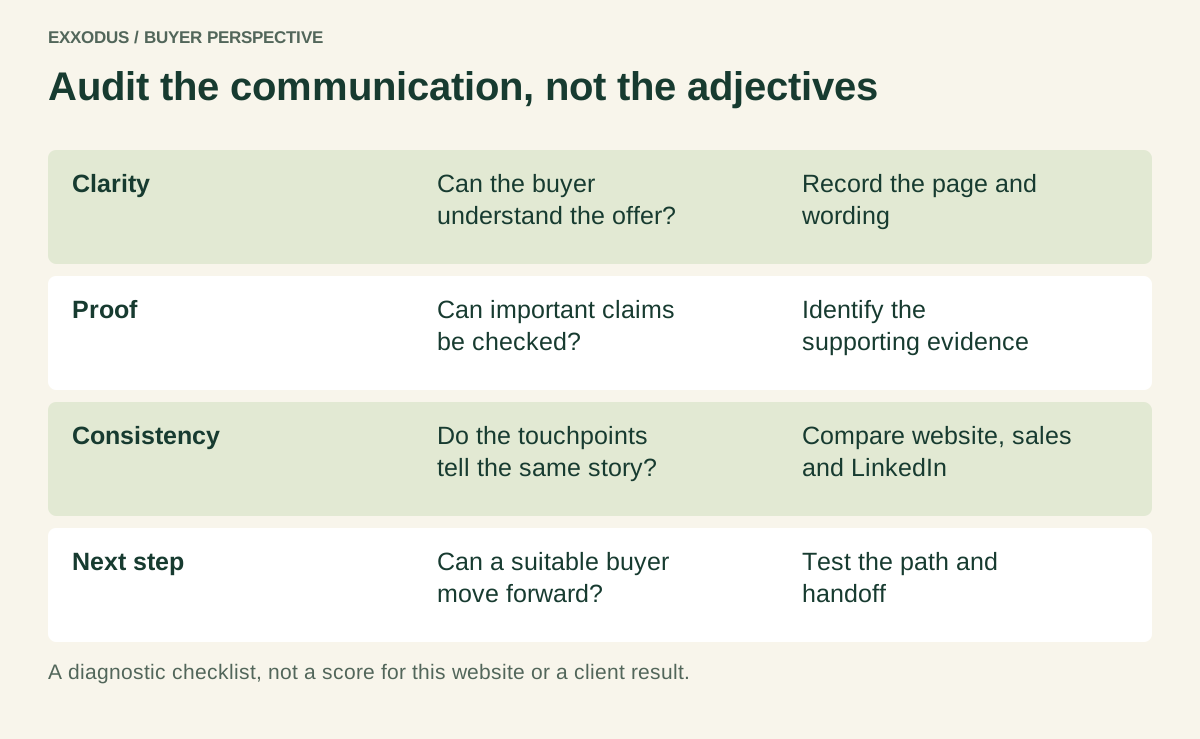
For a communication-focused audit, that means examining the clarity of the offer, the evidence behind claims, consistency across touchpoints, and the next step presented to buyers. This guide lays out a practical way to distinguish what you observed from what you merely suspect, and to turn the findings into priorities rather than another impressive-looking spreadsheet.
Define the audit before opening twenty tabs
“Audit the marketing” can mean analytics, advertising economics, brand positioning, search visibility, content, sales operations, technical SEO, and more. Those are different scopes requiring different evidence and specialists. A communication-focused audit should not pretend to certify cybersecurity, advertising attribution, or website code quality.
State the audience, priority offer, pages and channels to review, decision you hope to support, and limitations. For example: “Assess whether the website and LinkedIn explain our custom packaging capabilities clearly enough for suitable buyers to decide whether to inquire.”
That is a workable question. “Fix marketing” is a wish.
Start with the buyer and the commercial objective
Ask which customers the company wants, what it can profitably deliver, which inquiries are unsuitable, and what sales most often has to clarify. Without that context, a generic recommendation to increase traffic may create more work without improving opportunities.
Review a small sample of wins, losses, and stalled deals where available. Note the applications, buying roles, common objections, and points where buyers lacked information. Separate what stakeholders report from what you can verify in actual pages or records.
Audit the buyer journey, not just the marketing channels
A channel inventory tells you where the company communicates. A buyer-journey audit asks whether that communication helps people make a decision. Those are not interchangeable questions.
A manufacturer can have an active LinkedIn account, polished capability pages, and a beautiful brochure while leaving procurement, engineering, and operations to assemble the evidence themselves. The audit should identify those gaps without assuming that every industrial purchase follows a neat, linear funnel.
Start with a recent, representative buying situation: a packaging producer considering a new film supplier, for instance. At problem recognition, does the manufacturer explain common application challenges such as seal integrity or production-line compatibility? During solution research, can the buyer find the relevant material options and meaningful limitations?
When comparing suppliers, are testing methods, quality processes, and case evidence available where permission allows? During internal validation, can the engineer assess technical fit while procurement understands commercial requirements and operations considers implementation? At inquiry or RFQ stage, is there a clear route for both an early feasibility question and a specification-ready quote?
This is a diagnostic framework, not a promise that every buyer reads the same five pages in the same order. Industrial decisions can loop backward, involve distributors, or begin with a supplier already known to the team. Ask sales and customer-facing engineers where buyers actually get stuck.
Record the stage, decision-maker, question, existing asset, missing evidence, and likely consequence. That creates a content-gap map tied to commercial decisions rather than a list of channels that need “more content.”
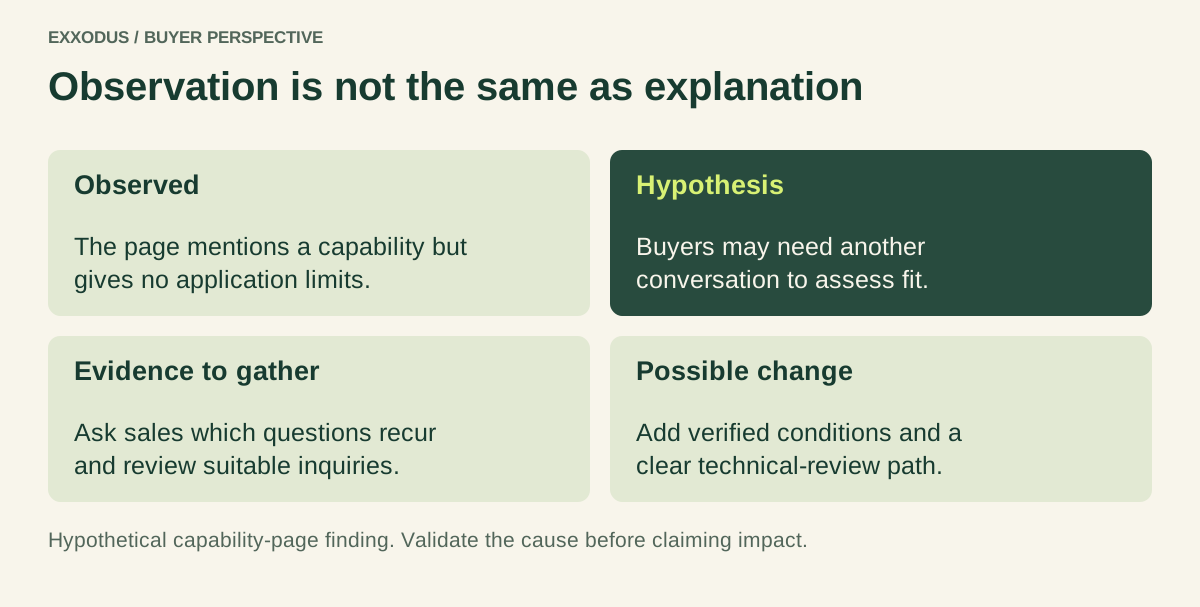
For example, suppose a packaging supplier publishes extensive product descriptions but no approved explanation of printing proof approvals, minimum runs, or compatibility considerations. The observed gap is missing decision information at the supplier-evaluation stage; the hypothesis is that qualified buyers may need additional sales conversations before shortlisting the company.
Verify that hypothesis against actual buyer questions, lost-opportunity notes, or sales interviews before assigning impact. The remedy might be a practical FAQ or application guide, not a full website redesign.
Check timing and handoffs between touchpoints
Consistency matters, but timing matters too. A technically accurate brochure that sales shares only after the third meeting may be unavailable when a buying committee makes its initial shortlist. A LinkedIn post can attract attention without answering the next technical question.
An audit should trace how buyers move from an initial claim to the supporting evidence, then to the appropriate contact or RFQ path. Look for dead ends, premature sales requests, and important documents hidden behind unnecessary friction. Do not prescribe a CTA on every asset: a specification table and a request-for-quote form serve different purposes.
Check whether the offer is understandable
Read the homepage and priority service pages as someone unfamiliar with the company. Can you identify what it makes, whom it serves, where its capabilities apply, and which constraints matter? A headline saying “Solutions that move industries forward” does not answer the same question as a description of specific processes and applications.
Record the exact wording, page location, and likely buyer confusion. Do not call a message “bad” because you dislike its style.
Explain what information is missing and which decision it prevents. That makes the recommendation testable.
Look for proof behind important claims
List major claims: precision, speed, reliability, quality, engineering support, compliance, or service. For each, ask what evidence the page provides. That could be an approved specification, certification with scope, inspection description, project example, or documented process.
If a claim is unsupported on the page, that is an observation. It does not prove the company lacks the capability.
The hypothesis is that buyers may hesitate because they cannot evaluate the claim. The next step is to ask the technical team whether suitable proof exists and can be published.
Compare the story across website, LinkedIn, and sales material
A buyer might see a LinkedIn post about rapid prototyping, a website focused on large production runs, and a sales brochure describing a different minimum order. The issue is not simply inconsistent wording; it may create uncertainty about what the supplier actually offers.
Create a small message matrix: audience, promise, evidence, limitation, next step, and source location. Note differences that matter to a buying decision. Do not force every channel to use identical copy; consistent facts and positioning matter more than matching adjectives.
Follow the next step as a buyer would
Can a visitor locate the relevant capability page? Is there a suitable path for feasibility questions versus a quote-ready RFQ?
Does the form explain required information, attachment handling, and response expectations? Try the journey on mobile and confirm the acknowledgment and routing where you have authorized access.
A broken form is an observable defect. A low conversion rate without reliable analytics is not.
A page with no relevant CTA may create friction, but the recommendation depends on what the visitor is trying to accomplish. The audit should explain the context rather than paste “add more buttons” onto every page.
Separate observation, hypothesis, and evidence
This distinction keeps audits honest. Observation: the capability page does not list supported materials. Hypothesis: buyers may need to email sales to confirm fit.
Evidence to seek: recurring material questions in inquiry emails, call notes, or customer interviews. Recommendation: publish an approved materials overview and check whether those questions decrease.
An audit that labels every preference a “critical issue” creates noise. Use confidence levels and specify what would change your assessment. If the team has no data about lead quality, say so; do not turn the absence of evidence into a fabricated performance diagnosis.
Prioritize by impact, effort, and confidence
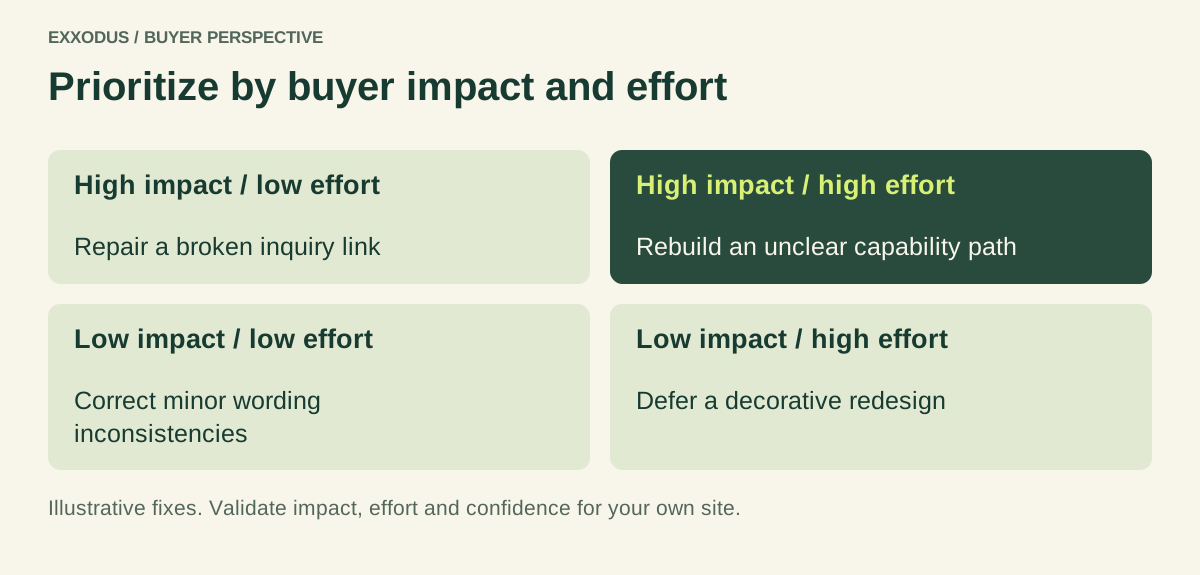
A useful priority system weighs buyer impact, commercial relevance, implementation effort, and strength of evidence. Fix a nonworking RFQ attachment before launching a six-month content calendar. Clarify a confusing capability headline before buying traffic to the page.
Use a simple matrix: issue, evidence, buyer consequence, proposed fix, owner, effort, and success check. Avoid precise scoring formulas that imply more certainty than the underlying observations support. Three changes implemented are worth more than forty recommendations nobody owns.
What a focused audit should deliver
For a small express review, examine one priority webpage and one company social profile, including a limited sample of posts. Identify the most consequential communication gaps and offer two or three actionable recommendations where the evidence supports them. Do not promise a full performance diagnosis from a narrow sample.
A deeper paid communication audit can include a questionnaire, website and LinkedIn review, available sales materials, prioritized findings, and a short report. Explain what was reviewed, what was not, and which conclusions require more data. A deliverable should help the client decide what to do Monday morning.
Check whether the fixes worked
Set a baseline before making changes: suitable inquiries, recurring buyer questions, quote-request completeness, or time to first useful response. Choose measures tied to the problem. Search impressions alone cannot prove the revised message improved buyer understanding.
After changes, review a comparable period and ask sales what changed in conversations. Account for seasonality and long industrial buying cycles.
If buyers still ask the same question, investigate whether the information is buried, unclear, or simply not what they need. Auditing is a decision process, not a one-time verdict.
A worked audit finding, without imaginary analytics
Suppose a manufacturer’s homepage says “Advanced manufacturing solutions,” while its capability page lists CNC machining but no applications or material information. Observation: the visitor cannot readily determine whether the company handles the intended type of work. Hypothesis: suitable prospects may need extra contact with sales to establish basic fit.
Evidence to seek: recent inquiries asking about materials, applications, or minimum order requirements. Recommended fix: add an approved summary of target applications and material capabilities to the relevant page.
Success check: compare the kinds of basic fit questions sales receives after the update. Nothing here requires pretending we know the conversion rate.
A communication-audit checklist you can actually use
Clarity: can a new visitor explain the offer and audience? Relevance: does the copy address a real buyer application? Proof: can important claims be checked?
Consistency: do the website, LinkedIn, and sales materials describe the same capabilities? Limits: are important exclusions or dependencies visible? Next step: can buyers act according to their stage of readiness?
For each item, capture the URL or document, exact observation, likely consequence, evidence confidence, and proposed action. Avoid filling the report with screenshots that do not support a recommendation. The value is the connection between what you found and what the business should do.
Add a buyer-stage field to that record: problem recognition, solution research, supplier evaluation, internal validation, or inquiry. Note the relevant role and question, not merely the page type.
A useful finding might read: “Supplier evaluation / engineering / supported materials unclear / capability page / confirm approved material list with technical lead.” This makes the recommendations actionable without claiming to know conversion outcomes that have not been measured.
Turn the report into a manageable 30-day plan
In week one, validate the most important findings with sales and a technical owner. In week two, rewrite one priority message and collect the proof needed to support it.
In week three, repair the highest-friction buyer path, such as a confusing inquiry page. In week four, review the revised material and establish a baseline for the next measurement period.
That schedule is an illustrative plan, not a guaranteed outcome. A larger site or regulated application may require more review time. The principle is to make a few well-supported improvements and learn from them before funding a wider redesign or campaign.
Questions to ask before commissioning an audit
What decision will this review inform? Which products, markets, or customer groups matter most? What can the team actually change in the next quarter?
Which evidence is accessible: sales questions, inquiry records, page analytics, approved specifications, or customer interviews? Who will validate the technical claims and own implementation?
These questions prevent a common failure: receiving an elegant report that the organization cannot use. If the business has no capacity to rebuild its website this quarter, prioritize corrections to a handful of commercially important pages.
If the sales team lacks a shared definition of a suitable inquiry, establish that before interpreting lead counts. The best audit scope is the one that produces a defensible decision.
A final reality check for the recommendations
Before presenting the audit, read each proposed fix and ask whether the client has the information, permission, and operational capacity to implement it. A recommendation to publish customer results is not actionable if no customer has approved them. A recommendation to promise faster quoting is irresponsible if the estimating team cannot deliver.
Write the next action at a level that someone can own: interview the sales lead about recurring qualification questions, verify the supported material list with engineering, revise one capability page, or test an RFQ confirmation. A useful manufacturing marketing audit should leave the company with a smaller number of better decisions, not a larger number of unassigned tasks.
Frequently asked questions
What is included in a manufacturing marketing audit?
It depends on scope. A communication audit examines messaging, evidence, consistency, buyer pathways, and practical recommendations; technical SEO, paid media, and security require separate expertise.
Can a small manufacturer do an audit internally?
Yes. Start with a priority offer, a handful of real buyer questions, and a focused review of the pages and materials sales uses most.
How often should we audit marketing communication?
Review priority messages when capabilities or markets change, and revisit key pages periodically using actual buyer feedback.
Should a communication audit include the industrial buyer journey?
Yes, when the scope includes how prospects research, evaluate, validate, and contact suppliers. The goal is to locate information gaps and friction at meaningful decision points, not to assume a single funnel or replace a full customer-research project.
Give the buyer something useful to work with
Before spending more to attract visitors, make sure the company can explain what it does, show why its claims are credible, and help the right buyer take the next step. A focused audit does not need to be dramatic.
It needs to be specific enough that someone can act on it. Exxodus offers communication audits for industrial B2B businesses, starting with the gaps that matter most to buyer understanding.
Sources and further reading
[1] Google Search Central, “Creating helpful, reliable, people-first content” (editorial quality framework, not a manufacturing audit standard) ↗
[2] NIST MEP, “Challenges, Solutions, and Success Stories Across the MEP National Network” (manufacturing business challenges) ↗
[3] Nielsen Norman Group, “B2B Usability” (older B2B buyer-information research) ↗