A machine does not have one buyer
Why can five intelligent people examine the same machine and reach five different conclusions? Because they are not evaluating the same risk. Engineering may focus on compatibility, operations on downtime, procurement on supplier terms, finance on capital exposure, and quality on validation.
The industrial buyer journey is therefore less like a neat funnel and more like a negotiation among overlapping responsibilities. Suppliers who treat it as a single person moving smoothly from awareness to purchase miss the real work buyers must complete. This guide shows how to map those decisions, identify evidence gaps, and help a buying group make progress without pretending that one brochure can answer every objection.
The industrial buyer journey is the work a group does to recognize a need, compare approaches, reduce risk, approve an investment, implement it, and judge whether it delivered. It is not a tidy parade from awareness to consideration to decision.
People enter late, revisit earlier questions, and occasionally reopen a choice everyone thought was settled. Your communication should make those movements easier rather than forcing everyone through one identical brochure.
Begin with the trigger, not the marketing funnel
A manufacturer rarely wakes up and decides to buy a case packer because a supplier published an inspiring LinkedIn post. A capacity constraint, safety concern, product change, maintenance issue, or customer requirement creates pressure to act. The trigger matters because it changes what evidence the buyer needs.
A team replacing a failing machine may value service availability and installation speed. A team expanding a product line may care more about flexibility and future changeovers.
Interview sales and service about the last ten serious opportunities. Record what happened before the first inquiry, who first raised the issue, what made the project urgent, and what would have happened if the customer did nothing. Separate a real business trigger from the generic phrase 'looking for solutions.' The former helps you create relevant content; the latter helps absolutely nobody.
Map the people who can say yes, no, or not yet
For a hypothetical machinery project, engineering checks performance envelopes and integration requirements. Operations examines staffing, cleaning, changeover routines, and disruption during commissioning. Procurement assesses contract terms, delivery reliability, and supplier qualifications.
Finance reviews capital assumptions, operating costs, and alternatives. Leadership wants confidence that the purchase supports the broader business plan. A maintenance lead may not sign the contract but can identify a service concern that changes the recommendation.
Do not turn those roles into cartoon personas. A procurement manager is not automatically obsessed with the lowest price, and an engineer is not immune to commercial concerns. Map the actual questions each person asks, the evidence they trust, and the objections they can raise.
For one customer, a distributor or outside integrator may influence the decision as much as an internal executive. The point is to discover the group, not to assign five job titles because a template says so.

Help the group agree on what success means
Gartner reported in May 2025 that 74% of surveyed B2B buying teams showed unhealthy conflict during decision-making; its survey covered 632 buyers and was not limited to manufacturing. The same release reported that groups reaching consensus were 2.5 times more likely to describe a deal as high quality.
These figures are useful context, not a prediction for your next equipment quote. They suggest that a supplier who helps people reconcile different priorities may be more valuable than one who merely repeats product benefits.
Build a shared decision brief: the problem, nonnegotiable requirements, trade-offs, assumptions, unresolved questions, and evidence still needed. If speed matters, specify which operating conditions define speed.
If total cost matters, name the costs included and excluded. If flexibility matters, list the products and formats being considered. 'Best solution' is not a specification, and nobody can test it in a factory acceptance trial.
Build content around buying jobs
A useful journey map pairs the buyer's task with information that helps complete it. Recognizing a bottleneck calls for a diagnostic explanation. Comparing approaches calls for an honest trade-off guide.
Checking a supplier calls for application evidence and relevant limits. Securing approval calls for a concise internal summary.
Preparing implementation calls for responsibilities, milestones, and service expectations. Continuing after installation calls for training and support material.
Notice that not every stage needs a new blog post. A capabilities page, an application diagram, a test protocol, a short email from engineering, and a well-organized proposal may do more work than another thousand words about innovation. Choose the format based on the decision, not on what marketing finds easiest to publish.
Follow the information as it moves internally
Your sales contact is often translating your claims to colleagues who have never met you. Give that person a version they can forward without rewriting it. A one-page application summary can explain requirements, fit, limitations, validation steps, and the responsible technical contact.
A comparison sheet can distinguish measured performance from estimates and assumptions. A case study can show what happened under stated conditions, with customer approval.
Ask what gets lost between the discovery call and the internal meeting. Is the engineering drawing missing? Is the ROI model based on an unrealistic utilization rate?
Does procurement have a different version of the lead time? Internal consistency is a marketing problem as well as an operational one. Every conflicting answer creates more work for the buyer.
Use a realistic machinery example
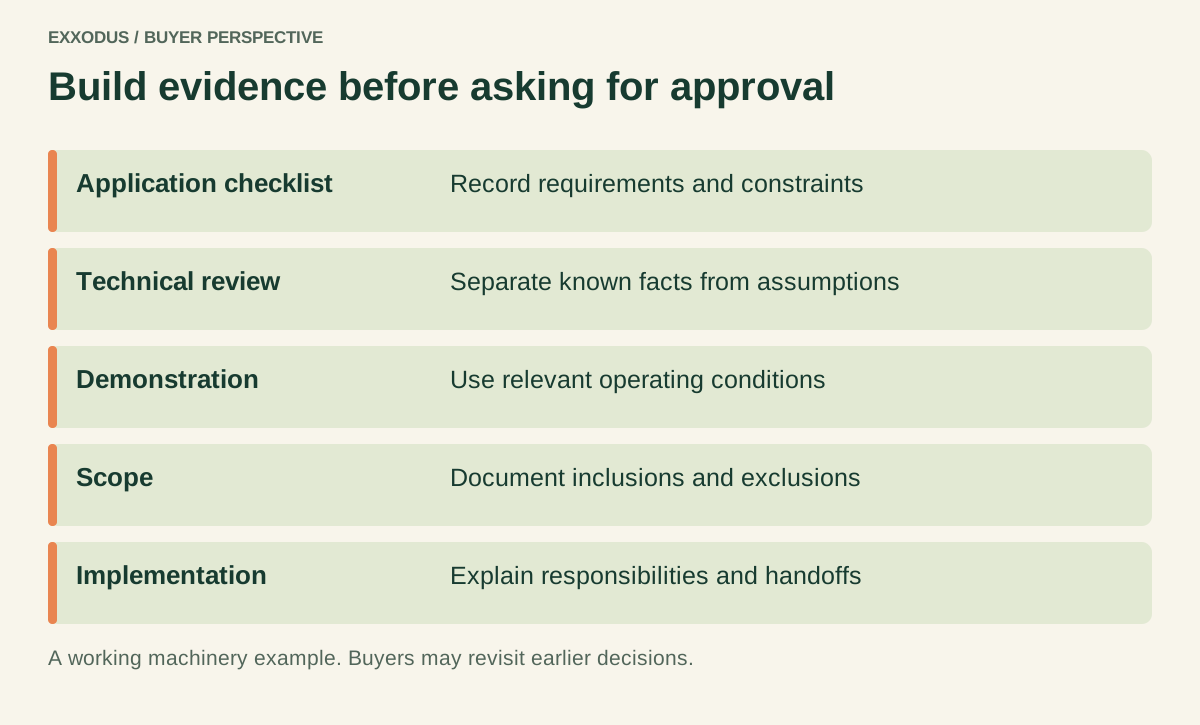
Imagine a regional food manufacturer considering an automated end-of-line system. The operations director wants to reduce manual handling; engineering needs to verify case dimensions and upstream integration; quality wants to understand product protection; procurement needs supplier documentation; finance needs a defensible investment model. A supplier that sends only a glossy product video has given the group one attractive object and five unanswered questions.
A stronger sequence begins with an application checklist, continues with a technical review, and produces a summary of known requirements and open assumptions. Next comes a demonstration under relevant conditions, a documented scope, and an implementation outline.
None of those steps guarantees a sale. Together they help the buyer discover whether the system is suitable before the organization commits to a very expensive misunderstanding.
Measure progress without inventing attribution
Record the questions that delay decisions, the materials buyers request, and the reasons opportunities stop. Separate lost deals from postponed projects and unsuitable applications.
A stalled project may reflect a capital freeze rather than weak copy. Ask sales which materials get forwarded, which require clarification, and which actually help people prepare an internal decision.
Use a small set of indicators: time to first useful technical response, percentage of suitable inquiries, common missing information, proposal revisions, and buyer-reported usefulness. Look at closed business over a realistic cycle. A visitor reading a comparison guide in October should not be credited with a machinery purchase negotiated since March.
A practical two-week journey mapping exercise
In week one, choose one product or application and interview sales, engineering, and customer support. Review five won opportunities, five lost or stalled ones, and the documents exchanged. Write down triggers, participants, objections, approval steps, and implementation questions.
Label assumptions as assumptions. You are building a working map, not commissioning a museum mural.
In week two, select the two most damaging information gaps. Perhaps buyers cannot find integration requirements or finance never receives a concise assumptions sheet. Fix those gaps, assign owners, and test the new materials on live conversations.
Revisit the map after a month. If the team keeps asking a new question, that is a signal to update the content rather than defend the original diagram.
Questions to ask after a lost decision
A lost deal review should distinguish a competitor winning on a verified requirement from a customer deciding not to buy at all. Ask whether the buying group agreed on the problem, whether an internal sponsor changed, whether the business case survived finance review, and whether the supplier gave each participant enough evidence. Review the actual documents sent, not just the CRM reason code.
If the team reports price as the explanation, ask what the buyer compared and whether the competing offers covered the same scope. Price may be decisive, but it can also become shorthand for a decision that was never fully understood.
Record findings without blaming the salesperson or customer. Then improve the one explanation that would have made the next decision easier to evaluate.
The key is to document what buyers needed at each handoff and to make that information available without claiming that a single communication asset controls the outcome. A useful review produces one concrete improvement, a named owner, and a date to check whether the change helped.
The missing stakeholder interview
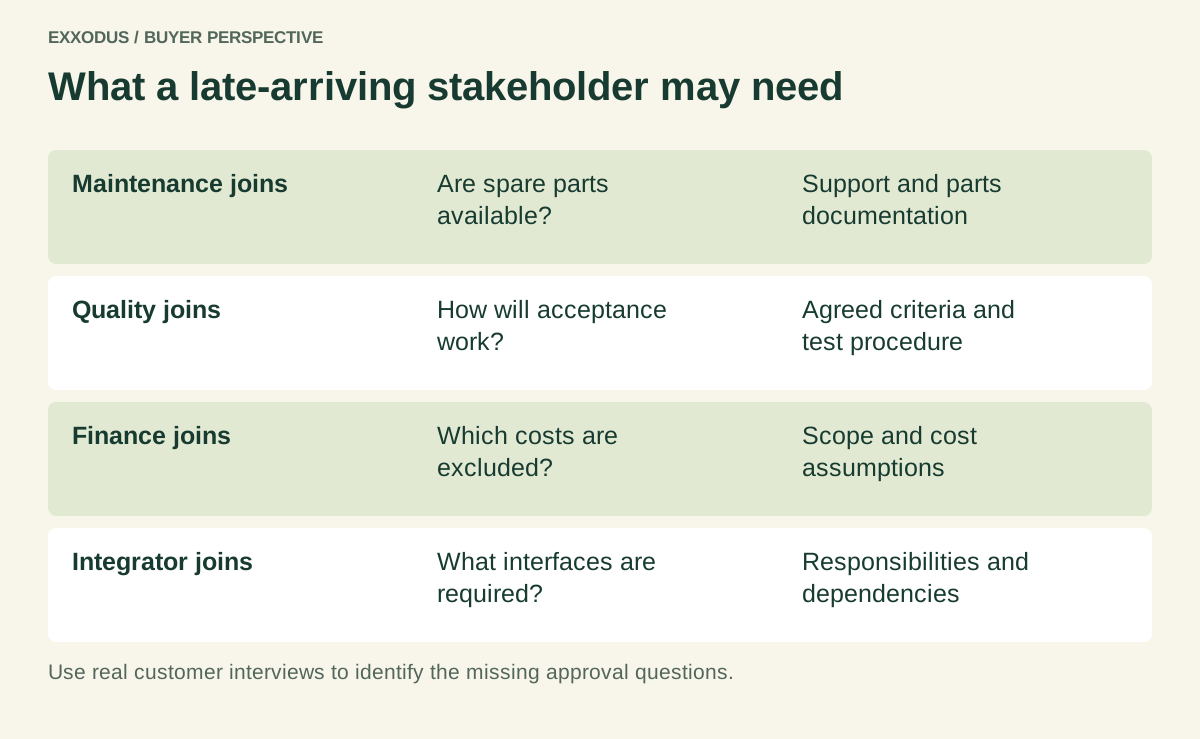
Ask a recent customer which colleague entered the project last and what they needed to see. That answer often exposes an overlooked approval step. Perhaps maintenance wanted spare-parts availability, or quality wanted a documented acceptance procedure.
Compare the customer's recollection with the supplier's CRM record. Differences are not failures of memory to be corrected with guesswork; they are clues that the recorded journey may be incomplete.
Ask permission before using customer details in public content. The aim is to build a better process for future buyers, not publish an unauthorized account of someone else's purchasing meeting.
What to include in an internal approval packet
A practical approval packet can contain a one-page problem statement, scope of proposed solution, key requirements, alternatives considered, assumptions behind projected benefits, known implementation dependencies, and unanswered questions. It should identify who supplied each estimate and when the estimate was last validated. The packet does not need to replace a formal proposal or engineering specification.
Its job is to give busy colleagues a coherent summary they can challenge intelligently. When the group asks for more evidence, the source should be easy to find rather than buried in a presentation whose filename includes the word 'latest' six times.
A journey map with actual decision gates
For the hypothetical case-packing project, gate one is problem confirmation: what is the capacity or handling issue and how is it measured? Gate two is feasibility: what products, cases, utilities, and floor-space constraints must be checked? Gate three is commercial justification: what costs, assumptions, and alternatives are being compared?
Gate four is supplier validation: which demonstrations, references, and documents are needed? Gate five is implementation readiness: who owns installation, training, acceptance, and support? Buyers may move backward between gates.
That is normal. Your materials should help them revisit an issue without restarting the entire conversation.
Different risk, different evidence
A replacement part bought routinely may require a specification, price, and delivery confirmation. A new line affecting throughput and staffing can demand months of cross-functional evaluation. Do not force both through the same communication journey.
Segment by decision complexity and consequences of failure. For a high-risk project, document integration dependencies, service response expectations, acceptance criteria, and what happens if the installation misses a milestone.
For a lower-risk reorder, removing friction may matter more than publishing another technical explainer. The useful map reflects the customer's risk, not your preferred content inventory.
Where marketing and sales divide the work
Marketing can create the common explanations, application pages, comparisons, and reusable evidence. Sales should identify the live project's unresolved questions and coordinate the next useful conversation. Engineering verifies technical claims and participates when feasibility requires specialist judgment.
Customer support contributes implementation and post-sale patterns. The handoffs need to be explicit.
If marketing publishes a capability claim sales cannot support, or sales promises a review engineering has never agreed to perform, the buyer experiences one company contradicting itself. Shared ownership is less exciting than a new campaign, but far more persuasive.
A final diagnostic for your team
Take one recent opportunity and reconstruct it from the buyer's point of view. What triggered the search? Who asked the first question?
Which document reached finance? What changed after the technical review? Which unanswered issue delayed the final approval?
Who explained implementation after the purchase? If you cannot answer those questions, do not invent a smooth funnel. Label the unknowns and investigate them.
The most useful outcome of mapping may be realizing how little of the decision your organization currently sees. That realization is a good place to begin.
Frequently asked questions
How many people are involved in an industrial buying decision? It depends on the project, company, and risk.
Gartner's 2025 release describes buying groups ranging from five to sixteen people across as many as four functions; that is broader B2B research, not a universal manufacturing rule. Map the people actually involved in your deals.
Is the industrial buyer journey the same as a sales funnel? No. A funnel tracks how a supplier manages opportunities; a journey examines the work buyers need to complete.
The two can inform each other, but one does not replace the other. What should a small manufacturer map first?
Choose one commercially important application and the last handful of real decisions. A modest, accurate map beats a beautiful, imaginary one.
Make the decision easier to defend
The strongest industrial communication does not pretend that every buyer wants the same thing. It makes requirements visible, gives each participant credible evidence, and helps the group resolve trade-offs before the final approval. If you want to improve one part of your manufacturing buyer journey this quarter, start with the question your sales team keeps answering privately and make the answer useful to everyone who needs it.
Exxodus works with industrial B2B companies to make complex capabilities easier to understand and evaluate. The first useful move is not necessarily a campaign. It may be one clear document that prevents five people from having five different versions of the same purchase.
Sources and further reading
Gartner, “Sales Survey Finds 74% of B2B Buyer Teams Demonstrate Unhealthy Conflict,” May 7, 2025 ↗
Content Marketing Institute, “Manufacturing Content Marketing Benchmarks, Budgets, and Trends: Outlook for 2025,” November 20, 2024 ↗