The brochure is not a sales strategy
If sales never opens the brochure, the brochure is not doing its job. That may sound obvious, yet industrial companies routinely measure their marketing materials by whether they were produced rather than whether anyone uses them to advance a difficult conversation. Sales enablement for manufacturing starts with the moments when a buyer gets stuck: an unresolved technical objection, a comparison the salesperson cannot substantiate, or an internal approval that needs better evidence.
A useful asset earns its place by helping somebody answer one of those questions. This article explains how to find those gaps, build a small library of reliable materials, and keep engineering, marketing, and sales working from the same facts.
Sales enablement for manufacturing means equipping commercial teams and channel partners with accurate information, usable materials, and clear processes that help qualified buyers evaluate a solution. It includes the ability to find the right asset, explain it correctly, and follow up on the specific question that matters.
The measure is not how many PDFs marketing creates. It is whether sales and buyers can use them.
Start with the conversation that keeps getting stuck
Review a sample of won, lost, and delayed opportunities. Ask sales which questions recur, which objections need technical input, which approvals take longer than expected, and which claims customers ask you to prove.
Do not begin by ordering a new corporate deck. A deck is a format, not a diagnosis.
Group gaps by decision: identifying fit, comparing alternatives, validating performance, calculating cost, assessing supplier risk, and preparing implementation. For each gap, name the buyer, the question, the evidence required, and the person responsible for accuracy. Then choose the lightest asset that can resolve it.
Match the asset to the buying task
A capabilities sheet helps a buyer establish whether your processes and materials fit. An application note explains how a product behaves under relevant conditions. A comparison guide presents trade-offs honestly.
A case study shows an approved real-world result. A technical datasheet states verified specifications. A decision summary helps your contact explain the recommendation internally.
Do not send all six because someone requested a quote. Send the item that answers the current question and tell the recipient why it is relevant.
A procurement manager evaluating supplier risk may need documentation and service terms rather than a ten-minute machine video. More material is not automatically more help.

Build a comparison that does not cheat
Suppose a customer is considering two packaging formats. A useful comparison states the applications, substrate considerations, equipment compatibility, printing constraints, approval process, and trade-offs.
It distinguishes measured data from assumptions. If your offering has a limitation, acknowledge it and explain when another option might be more appropriate.
A comparison designed to make every row turn green for your product is advertising disguised as analysis. Buyers who understand the application will notice.
Give them a fair decision framework, then demonstrate where your capability is a strong fit. Credibility is difficult to earn and surprisingly easy to lose in a spreadsheet.
Create proof the team can actually share
A strong industrial case study identifies the problem, constraints, intervention, evidence, and outcome. It explains measurement conditions and obtains approval for customer details.
If the customer cannot be named, describe the case anonymously without inventing results. If performance data is unavailable, a documented process demonstration may be more appropriate than a heroic percentage.
Gartner's May 2025 research on broader B2B buying teams highlights the challenge of achieving agreement across multiple participants. Materials that are easy to forward and verify help your champion communicate with colleagues. The salesperson cannot be in every internal meeting, but a concise, accurate explanation can.
Give sales a response library, not a script prison
Create reusable answers to recurring questions about applications, lead times, technical review, samples, installation, service, and constraints. Each answer should have a clear owner, approval status, last-reviewed date, and source documentation. Encourage sales to adapt the introduction to the actual customer rather than pasting a generic sequence into every inbox.
A useful follow-up refers to the buyer's unresolved issue: 'You asked whether the line can accommodate three case sizes. Here is the current range and what we still need to verify.' That is more helpful than 'just checking in.' Templates should reduce administrative effort without replacing judgment.
Equip distributors without creating five versions of reality
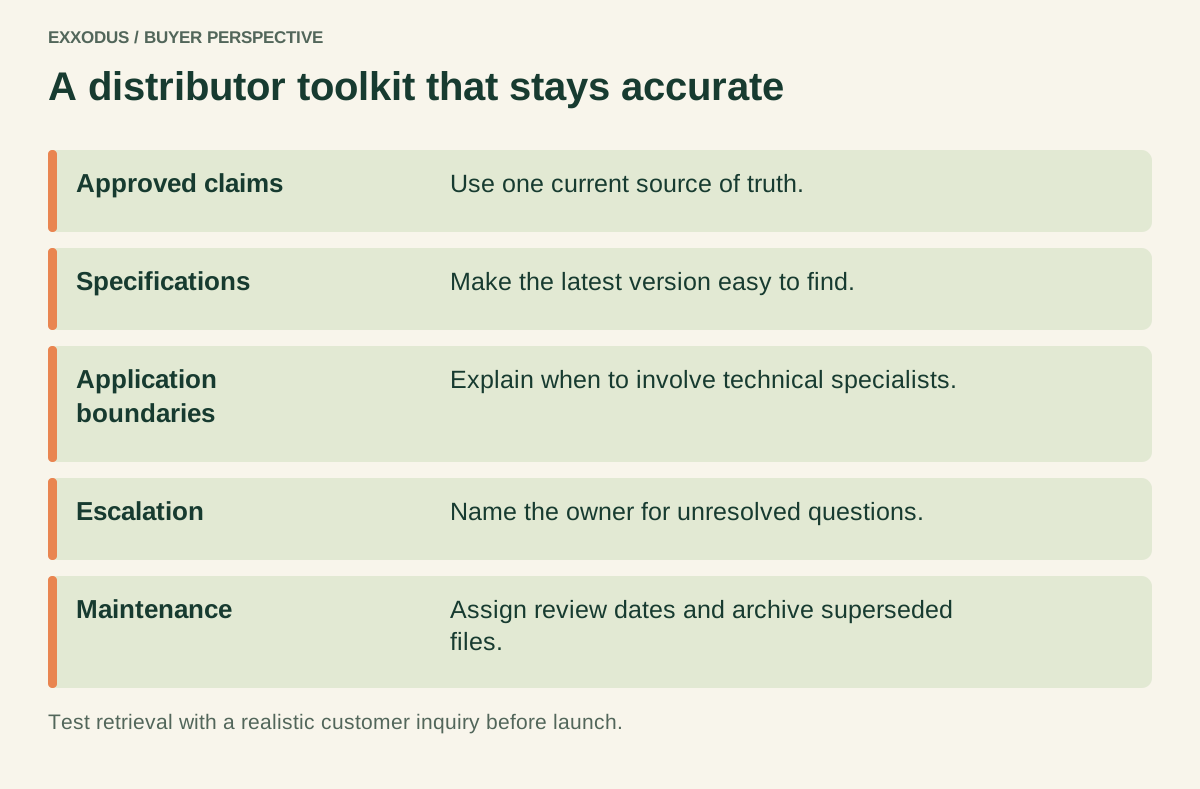
Channel partners may have less direct access to engineering and may sell competing products. Give them approved positioning, current datasheets, application boundaries, comparison criteria, and a reliable technical escalation route. Explain who owns a lead, who answers feasibility questions, and how changes to product information are communicated.
Ask a distributor to walk through a hypothetical customer inquiry using the toolkit. Watch where they hesitate or improvise.
That moment is more valuable than another internal meeting praising the new collateral. If the partner cannot locate the correct specification in two minutes, the system is not ready.
Design the library for retrieval and maintenance
Organize materials by application and buying question rather than internal department. Use consistent filenames, version dates, and a single approved location. Archive outdated assets.
Make it easy to distinguish public collateral from confidential proposals and internal guidance. A beautiful document that nobody can find is a very expensive secret.
Set a review cadence based on risk. Product specifications and claims require stricter control than general educational pieces.
Give engineering authority over technical accuracy, legal or quality teams authority over relevant regulated claims, and marketing responsibility for clarity. Document exceptions and approval paths so the process does not collapse when one colleague takes vacation.
Measure adoption and deal usefulness
Track whether sales uses the assets, which questions they answer, what still requires custom work, and whether qualified buyers progress with fewer clarification loops. A simple feedback field in the CRM can capture 'material shared,' 'buyer question,' and 'follow-up required.' Do not pretend that sending a PDF caused the sale by itself.
Compare a reasonable set of opportunities and ask sales for qualitative examples. If a new comparison sheet reduces confusion but deal velocity stays unchanged because capital approvals take six months, the asset may still be useful. Measure the job it was designed to perform.
A 30-day enablement pilot
Choose one product family and one recurring decision obstacle. Interview three salespeople and one technical reviewer. Create one buyer-facing asset and one internal guidance note.
Test both in real opportunities, collect objections, revise the wording, and decide who maintains them. The pilot should produce a repeatable process, not a ceremonial launch.
After thirty days, ask what sales stopped rewriting, what buyers found clearer, and which gaps remain. Expand only when the asset has a demonstrated use. The goal is a working library that supports decisions, not an impressive folder tree.
A sample internal sales workshop
Give three salespeople the same hypothetical inquiry: a food producer needs a new end-of-line machine but has not confirmed the case range or available footprint. Ask each person what they would send first, what they would ask next, and which claims require engineering verification. Compare the answers.
If one sends a general catalog, another promises a demonstration, and a third quotes immediately, the issue is not individual enthusiasm. The team lacks a shared decision process.
Use the exercise to build a short playbook, including what to do when the buyer cannot supply a complete specification. Repeat with a distributor or new hire to see whether the materials are genuinely usable without years of internal knowledge.
After the exercise, test the playbook on the next appropriate opportunity. Record whether it helped the team ask clearer questions, avoid unsupported promises, and share more relevant evidence. Revise the process before expanding it to other product families.
A useful launch checklist
Before rolling out a new sales asset, confirm that its claims have an owner, the current version is accessible, the intended buying question is clear, and sales knows when not to use it. Identify any missing evidence and how to request a technical review. Run through one actual inquiry with a colleague who did not help write the document.
If the colleague cannot identify the next step or misunderstands a limitation, fix the material before distributing it widely. After launch, ask whether the asset saved explanation time, reduced confusion, or improved the quality of the next conversation. Those observations provide a practical basis for improvement.
An asset-to-objection matrix
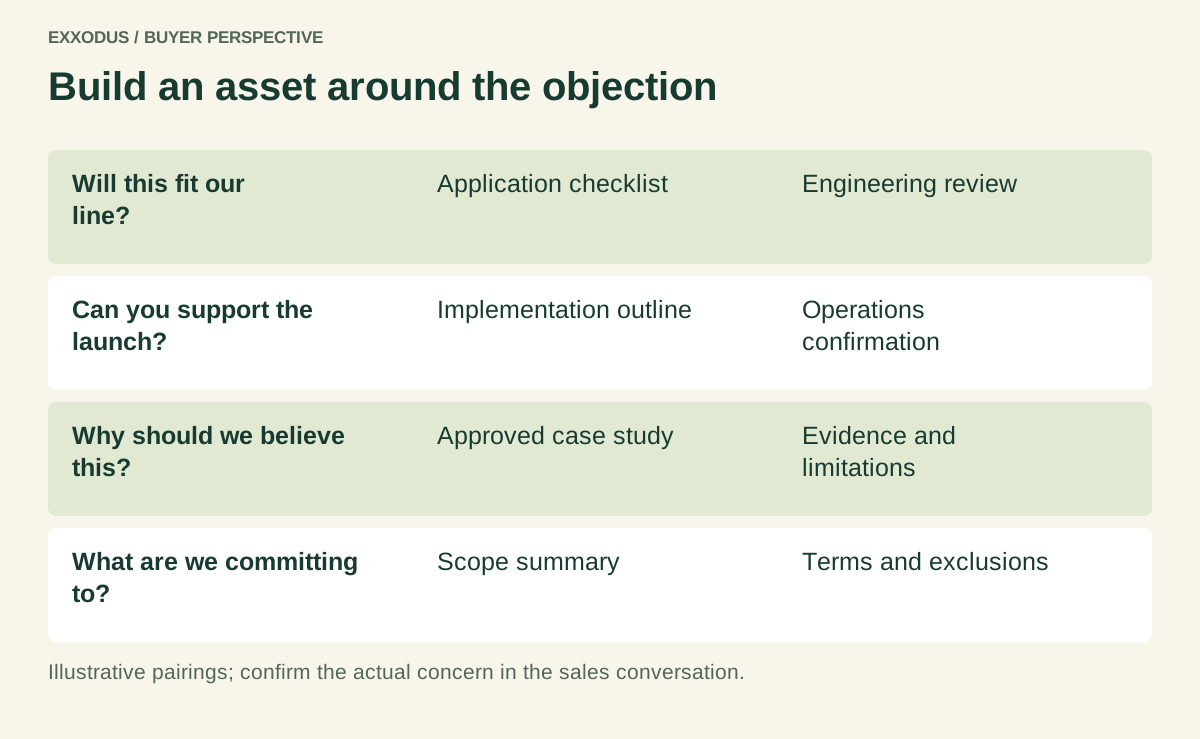
Build a simple matrix with four columns: buyer question, approved evidence, best asset, and owner. 'Will this fit our line?' may require an application checklist and engineering review. 'What happens after delivery?' may require an implementation outline and service contact. 'How do you know it performs?' may require test conditions and an approved case example. 'How does this compare with the alternative?' may require a trade-off sheet. This matrix tells marketing what to build and tells sales what to use. It also exposes questions the company cannot yet answer responsibly.
The proposal handoff problem
A technically sound proposal can still be difficult to approve when assumptions are scattered across attachments. Add a concise executive summary explaining the customer's objective, proposed scope, exclusions, dependencies, acceptance approach, and decision points. Link to detailed specifications rather than reproducing them inaccurately.
Use the customer's terminology where possible. Ask the account manager to verify that the summary reflects the latest discussion.
This is not about making a proposal prettier. It is about reducing the number of opportunities for a reasonable stakeholder to misunderstand what is being purchased.
When a datasheet is not enough
A datasheet can state dimensions, materials, ratings, and tolerances. It may not explain how those figures affect the customer's application. Pair it with a short application note when context matters: what the product is designed for, relevant compatibility conditions, and what requires testing.
Keep verified specifications separate from commercial interpretations. A buyer should be able to trace a claim to the underlying document. If the evidence is incomplete, state the question that engineering must resolve before anyone relies on the claim.
Train sales on limitations as well as strengths
A launch meeting should cover not only the headline benefits but also unsuitable applications, common misunderstandings, approval requirements, and escalation contacts. Practice a real objection. What should the salesperson say when a buyer requests a performance guarantee the team has not validated?
How should they respond to a specification outside the published range? The right answer may be to pause and consult engineering. A credible boundary is better than an enthusiastic promise that operations later has to unwind.
Collect feedback without creating bureaucracy
After an asset is used, ask the salesperson three questions: Did the buyer understand the point? What remained unresolved? What would make the asset easier to use?
Capture the response in a shared note or CRM field, not a twenty-question survey. Review patterns monthly with marketing and technical staff. If the same question keeps coming back, revise the content or create a different format.
If a material is rarely used, ask whether it is hard to find, irrelevant, outdated, or simply unnecessary. The answer determines whether to improve it or retire it.
A realistic ownership model
Marketing owns clarity, structure, distribution, and version control. Product management or engineering owns technical correctness. Quality and legal review claims where appropriate.
Sales owns contextual use and reports what buyers need. Leadership resolves trade-offs when resources are limited. In a small manufacturer one person may hold several roles, but the responsibilities still need names.
Without ownership, documents quietly age until someone sends an old claim to a prospective customer. That is not a sales enablement program; it is an archaeological site.
Keep the human judgment
Enablement materials should make competent conversations easier, not automate them into irrelevance. A buyer evaluating a standard repeat order may appreciate a fast self-service answer. A buyer planning a custom installation may need an expert to explain uncertainty and ask better questions.
Train teams to recognize the difference. The goal is not to eliminate contact with sales; it is to ensure that when a buyer does speak with someone, the conversation advances rather than repeats information that should have been available already.
Frequently asked questions
What is the difference between sales collateral and sales enablement? Collateral is the material; enablement includes the process, training, access, and feedback that make it useful. Should every manufacturer have a case study?
Only when there is an accurate, approved story to tell. A documented demonstration or application note can be valuable in the meantime.
How many assets should a small manufacturer create first? Start with the most repeated buyer question and the most costly information gap. One reliable comparison or technical summary may outperform a dozen generic brochures.
Who should own technical approval? The people qualified to verify the claims, with responsibilities defined before publication.
Make the next conversation better
Useful manufacturing sales materials do not replace expertise. They make expertise easier to apply consistently, especially when buyers need to explain the decision to colleagues. Start with the question that slows the deal, produce a credible answer, and make sure the right person can find it.
Exxodus helps industrial teams organize complex commercial messages into materials buyers and salespeople can actually use. If the content is only impressive in a presentation about the content, it still has work to do.
Sources and further reading
Gartner, “Sales Survey Finds 74% of B2B Buyer Teams Demonstrate Unhealthy Conflict,” May 7, 2025 ↗
Content Marketing Institute, “Manufacturing Content Marketing Benchmarks, Budgets, and Trends: Outlook for 2025,” November 20, 2024 ↗